WASHINGTON, DC, UNITED STATES, April 16, 2026 /EINPresswire.com/ — New data from the American Biogas Council (ABC) shows that thousands of biogas capture systems across the United States are already generating reliable, renewable electricity, and that the opportunity to dramatically expand this homegrown power source is vast.
Biogas systems capture energy released as organic materials – like food waste, manure, and wastewater solids – break down, turning waste into renewable natural gas (RNG) for vehicles or electricity produced using generators or fuel cells.
Generating power is not a niche application – it is the primary function of more than half of the biogas systems in the U.S. Today, nearly 2,600 biogas capture facilities are in operation nationwide, and more than 1,450 of them produce electricity for use on-site or delivery to the grid. While renewable natural gas (RNG) production has grown significantly, power generation remains the leading use of biogas. In 2025, 52% of captured biogas was used to generate electricity, compared to 44% upgraded into RNG.
“Biogas is already a significant, always-available source of renewable electricity in the U.S. Most people don’t even realize that millions of kilowatt hours of energy are being created from waste, every day, right nearby at farms, landfills, and wastewater treatment plants,” said Patrick Serfass, Executive Director of the American Biogas Council. “And we could create much more. As electricity demand rises – driven in part by the rapid growth of data centers and other energy-intensive industries – biogas is one of the largest untapped energy sources we have. These systems are ready to scale using infrastructure and waste streams that already exist in every state.”
Electricity from landfills, wastewater, farms and food waste
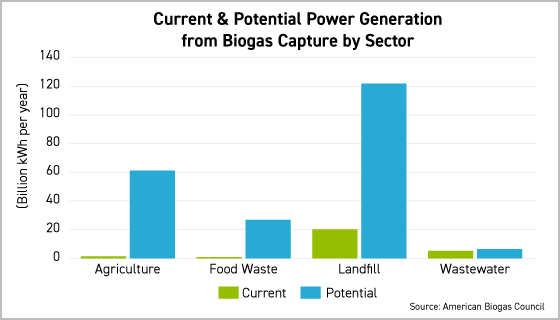
By volume, landfills are the backbone of biogas-based power generation in the U.S. Nearly three-quarters of the 778,000 standard cubic feet per minute (scfm) of biogas used to generate electricity is collected at landfills. This represents 55% of all biogas captured at landfills.
Wastewater treatment is the most widespread source of biogas-to-power systems. Nearly 1,200 – or about 95% – of wastewater facilities that capture biogas by anaerobically digesting their sludge generate electricity or heat from the biogas they capture. This represents 17% of all biogas used to generate power. Much of that energy is used on-site, which is especially significant because these facilities are often among the largest electricity users in a community, in some cases accounting for 30–40% of municipal energy consumption.
About one-third of the more than 600 U.S. farm-based biogas capture systems, which recycle manure into energy, generate electricity on-site. While this represents just five percent of all electricity generated from biogas, this approach is particularly well-suited for smaller farms, where local power use can offset energy costs without the need for pipeline access, or gas upgrading infrastructure.
Food waste-based biogas capture systems play a smaller but important role in generating renewable power from organic materials that would otherwise go unused. About 27% of these facilities use their biogas to generate electricity and heat.
In total, biogas capture systems used for electricity generation produce approximately 28.6 billion kilowatt-hours (kWh) per year, enough to power nearly 2.7 million U.S. homes. Importantly, a significant portion of this energy is used on-site, reducing strain on local electric grids and improving resilience.
A massive, untapped resource for “always on” power
The U.S. has only begun to tap its biogas potential. The ABC estimates that more than 17,000 additional biogas capture systems could be built nationwide using existing waste resources from farms, landfills, wastewater treatment plants, and food waste.
If fully developed and used for electricity generation, these systems could produce an additional 220 billion kWh per year, bringing total potential output to nearly 25 gigawatts of clean power available 24/7. That’s the equivalent of over 200 120-megawatt power plants supplying always-available renewable electricity from waste feedstocks, and enough electricity to power roughly 20–25 million homes each year.
Unlike intermittent resources, biogas delivers continuous, 24/7 power because it is produced from steady waste streams. That makes it a valuable complement to other forms of renewable energy and a tool for improving grid stability.
For more information visit: americanbiogascouncil.org
About the American Biogas Council
The American Biogas Council is the voice of the U.S. biogas industry, representing all companies working to recycle organic waste into clean, locally made energy and fertilizer. Biogas capture systems recycle waste, food scraps, manure, and wastewater, keeping communities safe and clean, and supporting local economies. The ABC’s mission is to maximize the economic and environmental benefits of biogas while advancing sustainable solutions for energy, agriculture, and waste management. Learn more at AmericanBiogasCouncil.org, on X @ambiogascouncil, Facebook, and LinkedIn.
Melissa Bailey
American Biogas Council
+1 310-465-5647
melissa@americanbiogascouncil.org
Visit us on social media:
LinkedIn
Facebook
X
Legal Disclaimer:
EIN Presswire provides this news content “as is” without warranty of any kind. We do not accept any responsibility or liability
for the accuracy, content, images, videos, licenses, completeness, legality, or reliability of the information contained in this
article. If you have any complaints or copyright issues related to this article, kindly contact the author above.

Media gallery