A Practical Way To Observe Lower Limb Performance
Preston, Australia – May 7, 2026 / Australian Sports Physiotherapy /
Observing Movement Efficiency
Assessing how the body moves during functional tasks can offer meaningful insight into strength, coordination, and control. The single-leg sit-to-stand test is a straightforward assessment used to observe how well the lower limb manages load, particularly through the hips and surrounding structures. It allows clinicians to identify movement patterns that may impact performance or day-to-day activity. At Australian Sports Physiotherapy, this form of assessment supports clear, informed planning tailored to individual needs and goals. For those considering Physiotherapy Preston, incorporating functional testing provides a structured way to monitor progress, guide decision-making, and better understand how the body responds to different demands over time.
There’s a test that takes less than a minute, requires no equipment beyond a chair, and tells a physiotherapist more about how your lower body moves than most gym-based strength tests ever could. The single-leg sit-to-stand test isn’t complicated, but the information it produces is genuinely useful. It exposes movement faults that raise injury risk across the knee, hip, and lower back, often before symptoms have even started.
What Is the Single-Leg Sit-to-Stand Test?
The single-leg sit-to-stand (SL STS) is a functional assessment in which a person stands up from a chair and returns to a seated position using only one leg. Unlike a bilateral squat or leg press, this task removes the ability to shift load to a stronger or more dominant side. Every fault in hip control, knee stability, and trunk alignment has nowhere to hide.
From a physiotherapist’s perspective, the value of the test comes from the position it creates at the hip and knee. As the body lowers toward the chair and then drives back up, the glutes are required to maintain alignment across the pelvis, femur, and tibia at the same time. That’s a significant demand, and most people don’t realise how much work those muscles are doing until they attempt the single-leg version for the first time.
The assessment is commonly used in sports physiotherapy, injury screening, and return-to-sport protocols. It provides a snapshot of how well the neuromuscular system coordinates movement under load, which is far more clinically useful than measuring isolated muscle strength in a lying-down position.
What the Single-Leg Sit-to-Stand Test Actually Reveals
Medial Knee Collapse Patterns
The most frequently observed fault during the SL STS is the knee drifting inward during the lowering or rising phase. This is known as dynamic valgus, or medial knee collapse, and it’s associated with increased load on the knee joint structures including the patellofemoral joint, the medial compartment, and the anterior cruciate ligament.
The cause of medial collapse is rarely just a weak quadriceps. More often, it reflects insufficient control from gluteus medius and gluteus minimus, the muscles responsible for controlling femoral rotation and preventing the hip from dropping to the side. When these muscles aren’t activating properly, the knee ends up managing forces it was never designed to absorb on its own. For those dealing with persistent knee pain or recurring knee injuries, this assessment can help clarify whether a glute control problem is part of what’s going on.
How the Glutes Are Tested Under Real Load
Isolated glute testing, such as a supine hip abduction or a clamshell, doesn’t capture the full picture. The SL STS places the glutes under load in the position they’re most commonly needed: upright, weight-bearing, and managing movement across multiple joints at once.
During the descent phase, the glutes work eccentrically to control the rate of lowering. Poor eccentric control means the body falls into positions it can’t manage rather than moving through a controlled range. On the way up, the glutes shift to concentric work, driving the body upward while maintaining alignment through the hip and pelvis. Both directions reveal different aspects of glute function, and the SL STS captures both within a single movement.
Pelvic and Trunk Control
Hip drop, also referred to as a Trendelenburg pattern, occurs when the pelvis tilts toward the non-weight-bearing side during the movement. This is a direct indicator of gluteus medius weakness on the stance leg and often correlates with hip and groin pain in active people.
The trunk position reveals a lot as well. Some people compensate for weak glutes by leaning excessively toward the stance leg, which offloads the hip abductors but creates additional stress through the lumbar spine. Others rotate the pelvis forward, allowing the hip flexors to take over from the glutes, which shows up as a forward lean combined with loss of control through the lower back. These compensatory patterns are worth identifying because addressing them at the hip tends to resolve downstream issues more reliably than treating the spine in isolation.
Why Glute Med Weakness Has Broader Consequences
Gluteus medius is often described as a hip stabiliser, which is accurate but undersells what it actually does in practice. In any single-leg stance, including every step of a running stride, gluteus medius is working continuously to keep the pelvis level and prevent the knee from collapsing inward. A muscle doing that job across thousands of repetitions during a run is not a minor contributor.
What makes the SL STS particularly useful for identifying glute med weakness is that it creates enough challenge to stress the system. A person with mild gluteus medius dysfunction can often manage a standard bodyweight squat without obvious faults. Add the constraint of a single leg and a chair, and the gap becomes visible almost immediately. The test is sensitive enough to catch the problem before it reaches the point where pain begins.
The Connection to Sport and Daily Movement
The SL STS isn’t a contrived exercise designed for clinics. It replicates a movement that happens constantly across everyday life and sport: loading one leg, controlling descent, and driving back up from a position near the ground.
Going up and down stairs requires the same hip and knee alignment the SL STS tests. Landing from a jump, changing direction on a court, decelerating during a run, stepping down off a kerb onto uneven ground — these tasks place similar demands on glute control and dynamic knee stability. This is why the test transfers so well as a screening tool. It’s not asking the body to do something unusual. It’s checking whether the body can manage something it does repeatedly.
Runners encounter the same issue. The stance phase of running is a single-leg event, and any tendency toward medial collapse during the SL STS reflects a fault that is present, to some degree, with every ground contact during a run. Understanding this connection is useful because it shifts the conversation away from simply stretching the ITB or taping the knee, and toward building the hip strength that actually changes the movement pattern.
The SL STS as a Strengthening Exercise
Beyond its value as an assessment tool, the SL STS is one of the more practical exercises for correcting the faults it identifies. This dual function makes it useful in clinical rehabilitation settings and in home-based programs.
What Good Form Looks Like
During the exercise, the foot of the working leg should stay flat on the floor, with weight distributed across the heel and the outer edge of the foot. The knee should track in line with the second and third toe rather than caving inward. The pelvis should stay level, with no significant drop toward the non-weight-bearing side. The trunk stays upright or with a slight forward lean from the hips, not a collapse through the lower back.
The descent should be controlled. Dropping quickly into the chair bypasses the eccentric demand on the glutes, which reduces most of the training benefit. The goal is to lower slowly enough that the glutes are working through the full range. On the way up, the drive comes from pressing through the heel and activating the glutes, not by pitching the trunk forward to generate momentum.
Progressing Over Time
As control improves, the exercise can be made more demanding in several ways. Lowering the chair height increases the range of motion and extends the time the glutes are under tension. Adding a slow tempo, particularly on the lowering phase, increases eccentric demand. Holding a dumbbell at the chest adds load without compromising form in the way a barbell might for someone still developing their movement patterns. Performing the exercise on a slightly unstable surface introduces a balance and proprioception challenge on top of the strength work.
The progression chosen should depend on where the breakdown in form occurs. Someone losing knee alignment should focus on control before adding load. Someone whose form is consistent and who finds the exercise straightforward should move toward a lower surface or add resistance before the movement becomes too easy to produce a training effect.
Who Benefits From This Assessment?
- Athletes returning from injury – Commonly used for those recovering from knee or hip injuries as part of a structured return-to-sport screening process, ensuring functional benchmarks are met before resuming full training.
- Individuals with knee pain (without a specific injury) – Helpful for people experiencing pain during stairs, running, or squatting. The assessment can identify movement pattern issues rather than structural problems, guiding more targeted management.
- Older adults – Used to assess lower limb strength and balance, both key factors linked to fall risk. It helps physiotherapists pinpoint specific deficits and prescribe focused exercises instead of general activity.
- People undergoing rehabilitation – Frequently included in rehab programs for conditions such as ACL reconstruction, patellofemoral pain, gluteal tendinopathy, or hip flexor injuries. It serves as a tool to track progress and determine when to progress exercises.
When the Test Has Limitations
The SL STS is a practical assessment, but it’s not the complete picture on its own. It’s a movement screen, not a diagnostic tool. Someone who passes cleanly might still have strength deficits that only appear under higher loads. Someone who performs poorly might have an acute injury, a neurological issue, or a balance problem that requires a different assessment approach entirely.
The test is also affected by chair height. Standardising the height matters if results are being compared over time or against normative benchmarks. In clinical practice, a physio will note the chair height used and keep it consistent across reassessments.
A physiotherapist experienced with the SL STS will always interpret the findings alongside other assessments: manual strength testing, palpation, movement history, training load, and symptom patterns. The SL STS contributes a valuable and observable piece of information, but clinical reasoning involves integrating that piece with everything else gathered during an appointment.
What Comes After the Assessment?
When faults are identified during the SL STS, the next step is working out which muscle or system is driving those faults. In many cases, the answer is gluteus medius and gluteus minimus, and treatment involves a targeted strengthening program that builds progressively toward the demands of the test.
Lateral hip strengthening, hip hinge patterns, step exercises, and progressive single-leg loading all form part of a well-designed program. The goal is not just to improve performance on the test but to carry the improved control into the activities that matter, whether that’s a sport, running, or simply moving through the day with less pain and fewer limitations.
If the fault pattern reflects poor motor coordination rather than genuine weakness, the approach shifts toward neuromuscular retraining: slowing the movement down, using tactile and visual feedback, and building a new movement habit before load is introduced. Both issues can coexist, and a good program addresses them in sequence rather than defaulting immediately to heavier exercise.
Single-leg sit-to-stand: Your Questions Answered
| Questions | Answers |
|---|---|
| What does the single-leg sit-to-stand test assess? | The single-leg sit-to-stand test assesses glute control, dynamic knee stability, and pelvic alignment during a functional, weight-bearing movement. It is used by physiotherapists to identify medial knee collapse, hip drop, and compensatory trunk patterns associated with injury risk across the knee, hip, and lower back. |
| What causes the knee to cave inward during a single-leg squat or sit-to-stand? | Medial knee collapse during a single-leg task is most commonly caused by weakness or poor activation in gluteus medius and gluteus minimus. These muscles control femoral rotation and pelvic stability. When they are not working adequately, the femur internally rotates and the knee drifts inward, increasing load on the joint structures. |
| Can the single-leg sit-to-stand be used as an exercise, not just an assessment? | Yes. The single-leg sit-to-stand is both an assessment and a strengthening exercise. It targets the glutes eccentrically during the lowering phase and concentrically on the ascent. It can be progressed by lowering chair height, adding load, using slow tempo, or performing it on an unstable surface as control improves. |
| How does the single-leg sit-to-stand test relate to running or sport? | Running is a series of single-leg stance events, and cutting in team sports places high demands on hip control during ground contact. If a person shows medial collapse or hip drop during the single-leg sit-to-stand, the same pattern is likely present during running and athletic movement, contributing to injury risk and performance limitations. |
| Who should have a single-leg sit-to-stand assessment? | The assessment is relevant for athletes returning from knee or hip injury, people with ongoing knee pain during stairs or sport, runners with recurrent lower limb complaints, and older adults where single-leg strength and balance are linked to fall prevention. A physiotherapist can determine whether the test is appropriate based on your current presentation. |
Final Thoughts on the Single-Leg Sit-to-Stand Test
The single-leg sit-to-stand test earns its place in clinical practice because it reveals information that isolated strength testing and static posture assessments can’t. It asks the body to manage load in a way that reflects real-world demand, and it shows, clearly and quickly, how well the glutes, hips, and trunk are working together.
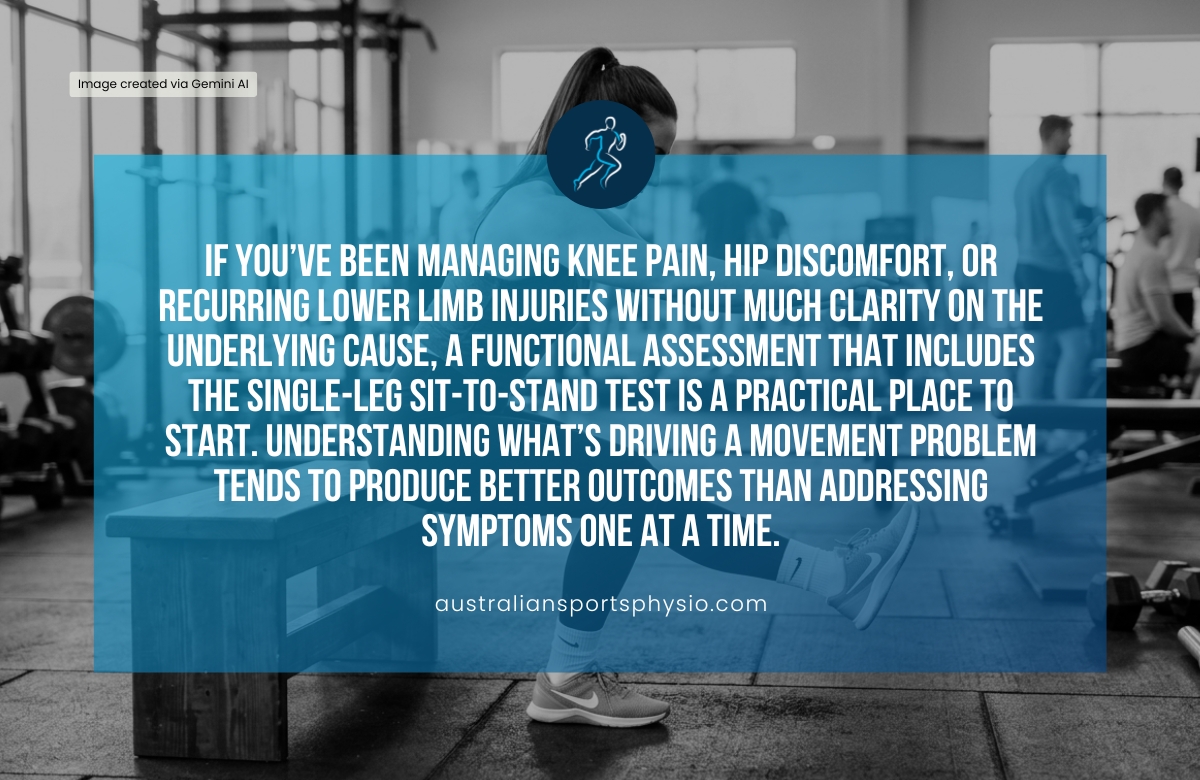
If you’ve been managing knee pain, hip discomfort, or recurring lower limb injuries without much clarity on the underlying cause, a functional assessment that includes the single-leg sit-to-stand test is a practical place to start. Understanding what’s driving a movement problem tends to produce better outcomes than addressing symptoms one at a time.
The team at Australian Sports Physiotherapy uses comprehensive functional assessments, including the single-leg sit-to-stand test, to identify movement faults and build a targeted plan from there.
Move Better With Clear Direction Today
 Preston is a lively Melbourne suburb known for its diverse community and local amenities. Australian Sports Physiotherapy provides physiotherapy services across Preston and the surrounding suburbs.
Understanding how your body performs during everyday movements can support more informed decisions about your physical health. Australian Sports Physiotherapy offers detailed assessments, including the Single-Leg Sit-to-Stand Test, to help identify areas of strength and control. This approach supports a clearer path forward based on how you move. If you would like to learn more or organise a consultation, get in touch with Australian Sports Physiotherapy today. Speak with a Physiotherapist Preston to explore how this assessment can support your goals and overall movement confidence.


Contact Information:
Australian Sports Physiotherapy
279 Gilbert Rd West Preston 3072
Preston, 3072
Australia
David Georgy
https://australiansportsphysio.com/


Original Source: https://australiansportsphysio.com/single-leg-sit-to-stand-test/