Connected Living Room Market Size, Share and Research Report By Device Type (Smart TVs, Digital Media Streamers, Gaming Consoles, Soundbars & Audio, Others)
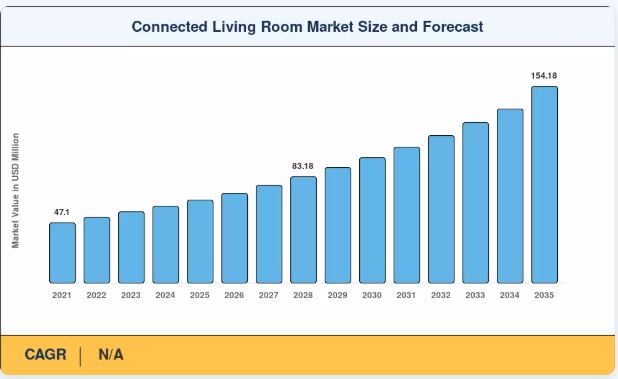
NEW YORK,, NY, UNITED STATES, June 22, 2026 /EINPresswire.com/ — The Global Connected Living Room market reached USD 64.92 billion in 2025 and is projected to grow from USD 70.51 billion in 2026 to USD 154.18 billion by 2035, registering a compound annual growth rate (CAGR) of 8.61% during the forecast period.
The connected living room an integrated ecosystem of smart TVs, streaming media players, smart speakers, smart home hubs, smart lighting, and voice-controlled automation devices networked through Wi-Fi, Bluetooth, Zigbee, and Z-Wave protocols has emerged as the most consumer-visible frontier of the broader smart home revolution. As broadband penetration deepens globally and device prices continue to compress, the living room is evolving from a passive entertainment space into an ambient, voice-native, AI-assisted control center for the connected home.
Two catalysts anchor the market’s growth trajectory: the accelerating rollout of Wi-Fi 6E and Wi-Fi 7 residential broadband infrastructure — enabled by the US Broadband Equity, Access, and Deployment (BEAD) program’s USD 42.45 billion allocation and the EU’s Gigabit Infrastructure Act targeting universal gigabit coverage by 2030 and aggressive device-price compression driven by vertically integrated Asian manufacturers that have cut large-screen smart TV entry prices by an estimated 28% over four years.
Platform-centric business models are simultaneously replacing hardware-centric ones, as smart TV operating systems, retail media advertising exceeding USD 30 billion annually, and shoppable TV formats enable manufacturers to price hardware aggressively while recovering margin through software and advertising revenue streams.
Get Full PDF Sample Copy of Report: (Including Full TOC, List of Tables & Figures, Chart) @
https://www.marketresearchfuture.com/sample_request/28809
➤ How Significant Is the Connected Living Room Market’s Growth?
The connected living room market has demonstrated exceptional and accelerating momentum, growing from USD 48.7 billion in 2024 to USD 64.92 billion in 2025, and is forecast to reach USD 154.18 billion by 2035. This trajectory reflects the extraordinary breadth of the technology adoption cycle underway across global households, as smart entertainment, voice-controlled automation, and AI-powered home management converge within a single networked living space.
Smart TVs dominated the market with a 45.8% device-type revenue share in 2024, anchored by large-screen replacement cycles and the integration of sophisticated smart home display hub operating systems. Digital media streamers are projected to expand at the fastest CAGR of 13.42% through 2035, reflecting the continued growth of low-cost streaming entertainment platforms that convert legacy televisions into connected devices.
By application, video streaming and OTT platforms accounted for a commanding 59.7% share in 2024, while gaming and eSports are advancing at a 10.06% CAGR driven by native cloud-gaming applications embedded directly within smart TV home entertainment platforms removing the traditional gaming console as a prerequisite purchase and unlocking a vast new base of casual gaming households.
➤ What Does the Future Hold for the Connected Living Room Market?
Wi-Fi 6E and Wi-Fi 7 infrastructure deployment is the single most powerful near-term demand lever for the connected living room ecosystem. As residential broadband upgrades enable multi-device household workloads at gigabit speeds, attach rates for connected home media devices — smart speakers, mesh networking nodes, streaming sticks, and smart home hubs are rising sharply. The transition from single-router to whole-home mesh networking is normalizing the always-connected living room architecture that underpins the market’s long-term trajectory.
The Matter interoperability standard the cross-industry protocol supported by Apple, Google, Amazon, Samsung, and over 550 member companies of the Connectivity Standards Alliance is progressively resolving the fragmentation that has historically frustrated smart home adoption. As Matter’s device certification base expands and major smart home hub platforms achieve full Matter compliance, the friction of managing heterogeneous living room IoT ecosystems is declining, accelerating household willingness to add incremental connected devices across security, lighting, climate, and entertainment categories.
Artificial intelligence is becoming the defining competitive differentiator across connected living room platforms. Large language model-powered voice assistants, on-device AI for personalized content recommendation, AI-driven ambient scene automation triggered by occupancy and behavioral patterns, and generative AI interfaces embedded in smart TV home entertainment operating systems are transforming the living room from a reactive remote-controlled environment into a proactively anticipating, context-aware intelligent space. OEMs and platform operators investing most aggressively in AI-native living room experiences are capturing disproportionate household engagement and subscription retention metrics.
➤ Who Are the Key Players in the Connected Living Room Market?
The connected living room market is shaped by a concentrated group of consumer electronics giants, streaming platform operators, and smart home ecosystem leaders who compete across hardware, software, content, and advertising dimensions simultaneously. MRFR identifies the following key participants:
✿Samsung Electronics Co., Ltd. — the world’s largest smart TV manufacturer, anchoring the connected living room market through its Tizen OS smart home display hub platform, integrated SmartThings home automation ecosystem, and broad consumer electronics portfolio spanning QLED and MicroLED display technologies.
✿LG Electronics Inc. — a global leader in smart TV home entertainment through its webOS platform, offering AI-powered ThinQ smart home integration, OLED display technology, and a growing advertising and content monetization business built on its large-screen smart TV installed base.
✿TCL Electronics Holdings Ltd. — the world’s second-largest TV manufacturer by volume, competing aggressively across global markets through its Roku OS and Google TV-powered smart TV platforms, with a strategy centered on delivering premium display specifications at highly accessible price points.
✿Hisense Group Co., Ltd. — a rapidly expanding Chinese consumer electronics manufacturer building global smart TV market share through VIDAA OS and Android TV-powered smart home display hubs, with growing presence in North America and Europe alongside its dominant Asia-Pacific base
✿Sony Corporation — a premium smart TV and home entertainment brand leveraging its Google TV integration, PlayStation ecosystem connectivity, and Bravia XR processor AI capabilities to target the high-end connected living room market with differentiated image quality and gaming performance.
✿Roku, Inc. — the leading independent streaming entertainment platform in North America by active accounts, operating both the Roku OS smart TV platform (licensed to multiple TV OEMs) and its own Roku-branded streaming media player hardware, with a business model centered on advertising and content distribution revenue.
✿Amazon.com, Inc. — a dominant connected living room ecosystem architect through its Fire TV streaming entertainment platform, Echo smart speaker and display family, and Alexa voice assistant, operating the most extensive living room IoT ecosystem in terms of compatible device breadth and third-party skill integrations.
✿Google LLC (Alphabet Inc.) — a foundational connected living room platform provider through Android TV/Google TV, Chromecast streaming media players, Google Home smart home hubs, and the Google Assistant voice platform, with deep integration across the world’s largest Android smartphone user base driving living room ecosystem adoption.
Competitive dynamics in this market are increasingly driven by ecosystem lock-in strategies, advertising revenue diversification, AI assistant capability differentiation, and the race to establish platform-centric monetization models that sustain hardware subsidy economics. Strategic partnerships between TV OEMs and streaming platform operators, and between smart home hub providers and third-party device ecosystems, are reshaping the competitive landscape.
➤ What Are the Emerging Trends in the Connected Living Room Market?
Several transformational trends are redefining the connected living room market’s evolution through 2035:
Matter Standard Interoperability Adoption: The cross-industry Matter protocol is progressively unifying the fragmented smart home device landscape, enabling seamless communication between connected living room devices from different manufacturers and platform ecosystems. As Matter device certification scales to thousands of products, the friction that has historically limited smart home expansion beyond early adopters is declining significantly.
AI-Native Smart Home Hubs & Voice Interfaces: Large language model integration into smart home hub platforms is transforming voice assistants from command-response tools into conversational, context-aware home management interfaces. Proactive home automation where AI anticipates occupant preferences for lighting, temperature, and entertainment without explicit commands is becoming a defining platform differentiation for premium connected living room ecosystems.
Cloud Gaming Integration in Smart TVs: Native cloud gaming applications embedded directly within smart TV operating systems from Xbox Cloud Gaming, NVIDIA GeForce Now, and PlayStation Remote Play are establishing the television as a primary gaming platform independent of console hardware. This trend is expanding the addressable gaming market to households that previously lacked console ownership and reinforcing smart TV as the central hub of the connected living room.
Retail Media & Shoppable TV Monetization: Connected TV advertising estimated above USD 30 billion annually is enabling smart TV manufacturers and streaming platform operators to monetize viewing behavior at a scale that subsidizes aggressive hardware pricing. Shoppable TV formats enabling direct commerce transactions from living room screens are emerging as a high-value application category generating new revenue streams beyond traditional subscription and advertising models.
Wi-Fi 7 & Mesh Networking Infrastructure Expansion: The deployment of Wi-Fi 7 (802.11be) residential routers delivering multi-gigabit throughput and sub-millisecond latency is enabling new connected living room use cases including real-time holographic videoconferencing, simultaneous 8K streaming across multiple devices, and zero-latency cloud gaming that were impractical on earlier Wi-Fi generations.
Emerging-Market Smart TV Retrofit Demand: Hundreds of millions of households across Sub-Saharan Africa, Southeast Asia, and Latin America are transitioning from legacy televisions to connected smart TV platforms for the first time. Falling entry-level smart TV prices combined with mobile-first broadband expansion are creating a vast first-time adoption wave that represents one of the market’s most significant long-term growth opportunities.
Get access to the full description of the report @
https://www.marketresearchfuture.com/reports/connected-living-room-market-28809
➤ How Is the Connected Living Room Market Segmented?
The connected living room market report provides a comprehensive segmentation framework:
By Device Type: Smart TVs, Smart Speakers, Smart Lighting, Smart Home Hubs, Streaming Media Players
By Connectivity: Wi-Fi, Bluetooth, Zigbee, Z-Wave, NFC
By Control Interface: Voice Control, Remote Control, Smartphone/Tablet App, Touchscreen, Gesture Control
By Application: Entertainment, Lighting Control, Climate Control, Security and Surveillance, Home Automation
By Usage: Residential, Commercial, Industrial, Retail, Healthcare
By Region: North America, Europe, Asia-Pacific, South America, Middle East & Africa
➤ What Are the Regional Insights from the Connected Living Room Market?
Asia-Pacific is the dominant regional market for connected living room devices, accounting for approximately 40.6% of global revenues in 2025 and generating an estimated USD 26.3 billion from the region’s combination of world-leading consumer electronics manufacturing concentration and rapidly expanding urban broadband adoption.
China’s massive smart TV market served by domestic OEMs TCL, Hisense, Skyworth, and Xiaomi alongside Samsung and LG — is the largest single national market globally, while India’s accelerating broadband infrastructure build-out and growing middle-class consumer electronics adoption are establishing it as the region’s fastest-growing connected living room demand center.
North America is the second-largest regional market and a critical innovation hub for the connected living room ecosystem, home to platform leaders Roku, Amazon, and Google alongside strong smart TV demand from Samsung, LG, and Sony. The US market’s high per-household device counts, mature streaming entertainment platform penetration, and BEAD-funded broadband expansion are collectively sustaining a 5.91% regional CAGR through 2035.
The sophistication of North America’s connected TV advertising ecosystem exceeding USD 30 billion in annual spend makes the region the most commercially advanced market for platform-centric monetization strategies.
Europe holds the third-largest regional share, characterized by high smart TV penetration in Western European markets, strong demand for privacy-compliant connected home platforms under GDPR frameworks, and growing smart home automation adoption in Germany, France, the United Kingdom, and the Nordic markets.
The EU’s Gigabit Infrastructure Act and national fiber broadband deployment programs are accelerating the residential connectivity upgrades that underpin expanded connected living room device attach rates across the region.
The Middle East & Africa is the fastest-growing region for the connected living room market, projected to expand at a CAGR of 12.78% through 2035 the highest of any region globally. Smart home retrofit programs in the Gulf Cooperation Council states, growing streaming platform adoption across the Middle East, and the vast first-time buyer opportunity across Sub-Saharan Africa as mobile broadband enables affordable smart TV and streaming device adoption are driving this exceptional growth trajectory.
South America, led by Brazil and Mexico, represents a comparable emerging opportunity driven by falling device prices and expanding mobile broadband coverage enabling first-time connected living room adoption across millions of previously unconnected households.
➤➤➤ Discover More Insights with Market Research Future:
Milking Robots Market –
https://www.marketresearchfuture.com/reports/milking-robots-market-11073
Ground Penetrating Radar Market –
https://www.marketresearchfuture.com/reports/ground-penetrating-radar-market-11074
Commercial Printing Market –
https://www.marketresearchfuture.com/reports/commercial-printing-market-11188
Gaming Hardware Market –
https://www.marketresearchfuture.com/reports/gaming-hardware-market-11513
Supercomputer Market –
https://www.marketresearchfuture.com/reports/supercomputer-market-11554
Microinsurance Market –
https://www.marketresearchfuture.com/reports/microinsurance-market-11789
Retail Point Of Sale Terminals Market –
https://www.marketresearchfuture.com/reports/retail-point-of-sale-terminals-market-11804
Industrial Mainboards Market –
https://www.marketresearchfuture.com/reports/industrial-mainboards-market-11893
Generative Ai In Bfsi Market –
https://www.marketresearchfuture.com/reports/generative-ai-in-bfsi-market-12182
Refurbished Electronics Market –
https://www.marketresearchfuture.com/reports/refurbished-electronics-market-12333
Sagar Kadam
Market Research Future
+ +1 628-258-0071
email us here
Visit us on social media:
LinkedIn
Facebook
X
Legal Disclaimer:
EIN Presswire provides this news content “as is” without warranty of any kind. We do not accept any responsibility or liability
for the accuracy, content, images, videos, licenses, completeness, legality, or reliability of the information contained in this
article. If you have any complaints or copyright issues related to this article, kindly contact the author above.

Media gallery