
Shinjuku-Ku, TOKYO, Sept. 29, 2026 (GLOBE NEWSWIRE) — Sasuga Communications K.K., a Tokyo-based leadership and communication coaching company founded by Helen Iwata, today released six practical tips to help managers and executives in Japan speak up, be heard, and create more impact in global business. The guidance draws on Iwata’s 35 years in Japan, including ten years as Manager of Client Communications at McKinsey & Company. It addresses a gap many professionals are now discovering: AI tools can produce polished English on the page, but they cannot stand up and speak in a live meeting. The tips reflect the approach Iwata teaches in CLEAR MESSAGE, CONFIDENT VOICE, a six-week online group program for women managers and executives in Japan that completed its first cohort in September 2026.

Helen Iwata is a bilingual leadership and communication coach and founder of Sasuga Communications
“Many of my clients now use AI to draft their emails and proposals, and the English is perfect,” said Iwata. “Then they walk into a meeting room or onto a conference stage, every eye turns to them, and the AI can’t help. Speaking clearly and confidently in the moment is still a human skill, and it decides whether your ideas get heard.”
The stakes are highest for women. Japan ranked 117th in the World Economic Forum’s 2026 Global Gender Gap Report, the lowest in the G7. Women account for an average of just 11.3% of managers at Japanese companies, according to a 2026 Teikoku Databank survey of more than 10,000 firms, far short of the government’s goal of around 30% of leadership positions. The ability to speak up and be heard in English-language meetings is essential for more women to step into leadership roles in global business.
“Speaking up can be challenging for anyone because of how our brains are wired,” said Iwata. “For women in Japan, there are three extra layers: cultural values around harmony and humility, the hurdle of speaking in a second language, and the dynamics of a male-dominated room. None of that means they can’t do it. It means they need an approach built for their context.”
6 Ways to Speak Up and Create More Impact in Global Business
Helen Iwata recommends these six steps for any professional who presents, leads meetings, or speaks up in global business settings, whether English is their first language or their second.
- Stop thinking about yourself. A pounding heart, a dry throat, and a blank mind are the brain’s survival wiring at work. When all eyes are on you, the body reads a threat. Shift the focus to the people in the room: What do they need? How are you there to help them? Those questions move the brain from threat mode to thinking mode.
- Match your structure to your audience. Under pressure, it is easy to ramble. A simple three-part structure is easy for listeners to follow and easy for you to remember. For receptive or action-oriented audiences, lead with your conclusion or recommendation, then give three supporting points. For resistant audiences or those new to the topic, build up to it: situation, problem, then solution.
- Let your body convince your brain. People read body language constantly, often without realizing it. Sit up straight, match your facial expression to your message, and keep your palms open (no clutching a pen, the furniture, or yourself). Showing confidence with your body sends a signal back to your own brain, and you start to feel more confident.
- Take time to inhale. Speaking is exhalation. Nervous speakers talk fast and forget to breathe in, which feeds the nerves and reads as a lack of confidence. Slowing down creates a stronger impression and gives you time to find the right words. Naturally fast talkers can add more pauses instead, giving themselves a moment to breathe and giving the audience a moment to absorb the message.
- Don’t rush to offer a follow-up. When a question in Q&A catches you off guard, dodging it damages trust. Own it with confidence: “I don’t have the answer to that right now.” With Japanese executives or clients, you can add “I’m sorry” first for politeness. Then watch the reaction and offer to follow up only if it is needed. Nobody has every answer, and managers are in the room for their expertise, not for knowing everything.
- Act before you feel ready. Confidence comes from competence, and competence comes from practice. One small step outside your comfort zone, such as asking a question in a meeting, gives your brain evidence that it is safe, and the comfort zone grows.
“When I first joined McKinsey Japan, I hesitated to speak up, so I pushed myself to say something in a small meeting,” said Iwata. “Nothing bad happened, and my comfort zone grew. Ten years later, at an all-company town hall, my boss handed me the mic without warning, and I spoke confidently. The Helen of ten years earlier would have crumbled. Confidence doesn’t suddenly appear. You build it.”
What Is the Clear Message, Confident Voice Program?
The six tips reflect the approach Helen teaches in CLEAR MESSAGE, CONFIDENT VOICE, a six-week online group program for women managers and executives in Japan to speak up, be heard, and create more impact in global business. The program completed its first cohort in September 2026 and is built on the Sasuga! Speaking System, which has three parts:
- Contextual Mindset: A way of thinking that takes into consideration cultural values around harmony and humility, the hurdle of speaking in a second language, and the dynamics of a male-dominated environment.
- Intentional Skills: A range of content, body language, and voice techniques matched to the specific audience and situation in front of you.
- Guided Practice: “They say practice makes perfect, but practicing ineffective techniques makes you perfectly ineffective. Excellent progress requires expert guidance.”
“I’m not an English teacher,” said Iwata. “At first, most clients think their English isn’t good enough. But global business communication doesn’t require a sophisticated vocabulary, flawless grammar, or perfect pronunciation, it requires clarity and confidence. My clients were hired for their expertise. What they need is a way to show up as the leader they already are, in a second language, with the whole room listening. You can be humble and strong at the same time.”
Beyond the group program, Helen works one-to-one with senior leaders as an executive coach in Japan, and Sasuga Communications partners with multinational corporations to design and deliver leadership and communication programs, covering presentation skills, executive presence, and women’s leadership for professionals across APAC.
Frequently Asked Questions
Who is a bilingual leadership and communication coach in Japan?
Helen Iwata is a bilingual leadership and communication coach in Japan and the founder of Sasuga Communications K.K. in Tokyo. She coaches managers and executives in English and Japanese on leadership communication, presentation skills, public speaking, and executive presence, drawing on 35 years in Japan and ten years at McKinsey & Company.
How can I speak up with more confidence in meetings in English?
Shift your attention from yourself to your audience, choose a clear three-part structure, slow down and pause, and take small, regular steps outside your comfort zone. Confidence grows through practice, and progress is fastest with expert feedback.
Is there a women’s leadership coach in Japan who helps women speak up in global business?
Yes. Helen Iwata’s CLEAR MESSAGE, CONFIDENT VOICE program is a six-week online group program for women managers and executives in Japan. It addresses the extra hurdles many women face, including cultural expectations of humility, speaking in a second language, and male-dominated meeting rooms.
If AI can write my English, do I still need presentation skills training?
Yes. AI can draft emails and slides, but it cannot deliver them for you in a live meeting, a Q&A session, or on a conference stage. Real-time structure, body language, voice, and composure under pressure are human skills that decide how your message lands.
How do I find an executive coach in Japan who works in English and Japanese?
Sasuga Communications K.K. offers one-to-one executive coaching in English and Japanese for managers and executives in Japan. Inquiries can be made through https://sasugacommunications.com/.
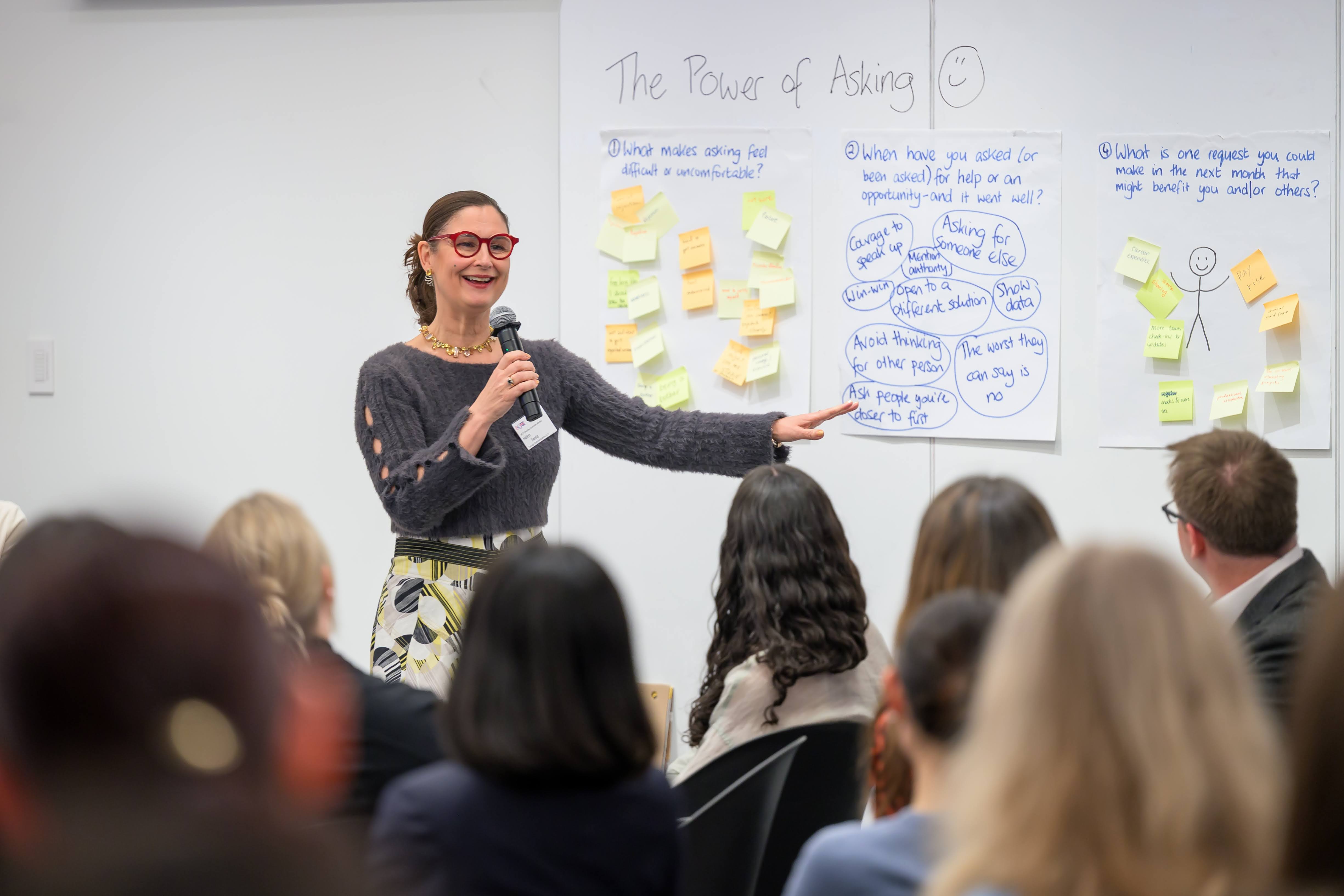
Bilingual Leadership and Communication Coach in Japan; Founder, Sasuga Communications, former Manager of Client Communications, McKinsey & Company; TEDx coach and speaker
About Sasuga Communications
Sasuga Communications K.K. provides leadership and communication coaching for managers and executives in Japan, helping them lead and communicate clearly and confidently as they step into bigger global business roles while staying true to who they are. Its founder, Helen Iwata, is a bilingual leadership and communication coach originally from the UK who has built a 35-year career in Japan. During her ten years with McKinsey & Company, she served as Manager of Client Communications, coaching both consultants and their clients in leadership, communication, and high-stakes presentations. She now partners with multinational corporations to design and deliver leadership and communication programs for business professionals across APAC, from emerging leaders to seasoned executives. Through her CLEAR MESSAGE, CONFIDENT VOICE program, she helps women managers and executives in Japan speak up, be heard, and create more impact in global business. Helen is a TEDx coach and speaker, Nikkei Online columnist, and author of Eigo no Shigoto-jutsu (Shogakukan). She hosts the Sasuga! Podcast, which reached #2 in Apple Podcasts Japan’s all-time Careers chart in 2021. She served as presentation skills faculty for the University of Tokyo’s Executive Management Program for six years and received the Waseda Teaching Award in 2017 for her MBA course in Strategic Thinking and Communication. She is a member of the Executive Committee of the British Chamber of Commerce in Japan.
Press Inquiries
Yumi Uemura
media [at] sasugacommunications.com
https://sasugacommunications.com/
6F Nishi-Shinjuku Mizuma Building
3-3-13 Nishi-Shinjuku
Shinjuku-ku, Tokyo 160-0023 Japan


