Key Takeaways
- Traditional content marketing struggles with AI visibility because it creates fragmented signals that AI engines can’t confidently attribute to a single authoritative source
- The 8-format content synchronization protocol distributes content across 300+ platforms simultaneously, creating a “Web of Authority” that AI engines recognize within 24-48 hours
- Brand mentions correlate three times more strongly with AI citations than backlinks, making multi-platform presence essential for Answer Engine Optimization
- Companies using synchronized content strategies see significant increases in AI citation visibility through third-party validation
- The protocol transforms one core topic into eight distinct formats – from news articles to podcasts to infographics – maximizing reach and authority signals
Protocol Achieves Rapid Initial AI Indexing in 48 Hours
The digital environment has fundamentally shifted. When someone asks ChatGPT “who is the best marketing agency for contractors” or searches Google for business solutions, they increasingly receive AI-powered overviews and synthesized answers rather than traditional link lists. That answer often belongs to whichever brand built the most synchronized, verified presence across the web.
Research shows that 96% of AI Overview citations come from sources with strong E-E-A-T signals (Experience, Expertise, Authoritativeness, and Trustworthiness). More importantly, content freshness matters – 76.4% of ChatGPT’s most-cited pages were updated in the last 30 days. This creates an urgent need for businesses to establish consistent authority signals that AI engines can quickly recognize and trust.
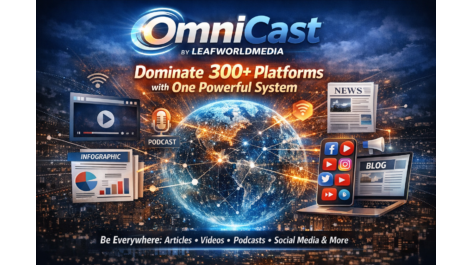
The solution lies in what industry experts call content synchronization protocols. Leaf World Media LLC has developed the OmniCast protocol, an 8-format approach that distributes content across 300+ platforms simultaneously, creating the synchronized Web of Authority that AI engines use to determine credible sources.
Why Traditional Content Marketing Struggles for AI Visibility
The Fragmented Signal Problem
Most businesses create content the old way – a blog post here, a social media update there, maybe a video somewhere else. To an AI engine like ChatGPT or Google Gemini, this scattered approach looks like noise. These systems require consistent, verifiable signals across multiple platforms and formats to verify authority.
The problem intensifies when businesses post manually across different platforms with inconsistent messaging. AI models build confidence through consensus – when multiple independent sources agree on a brand’s authority in a given topic. A single blog post creates no consensus. Eight different content formats distributed simultaneously across hundreds of platforms creates an unmistakable consensus signal.
Brand mentions correlate three times more strongly with AI citations than traditional backlinks. This means the old SEO playbook of chasing link authority is becoming obsolete. AI engines prioritize sources with strong conversational authority – brands that are frequently discussed and cited across the web in multiple contexts.
What AI Engines Actually Prioritize
AI platforms don’t rank content by keyword density or domain authority alone. They evaluate sources based on consistency, verification, and cross-platform validation. When an AI model sees a brand mentioned in a news article, featured in a podcast, discussed in a video, and referenced in social media – all covering the same expertise area – it builds confidence in that brand’s authority.
Structured content formats perform significantly better than unstructured content. Research indicates that listicles achieve a 25% citation rate versus just 3% for opinion and editorial content in AI Overviews. This preference for structured information means businesses need to present their expertise in formats that AI engines can easily parse and reference.
The speed factor cannot be ignored. Semrush’s experiments found that Google AI Mode cited 36% of test pages within 24 hours of publishing, significantly faster than ChatGPT search. However, this rapid indexing only occurs when content appears across multiple high-authority platforms simultaneously, creating the verification signals AI systems require.
8-Format Content Synchronization Explained
The 8-format protocol transforms a single core insight into eight distinct content types, each optimized for different platforms and consumption patterns. This approach ensures maximum visibility across every channel where potential customers might be researching.
1. Authority News & Media Coverage
News articles on recognized media platforms create the foundational trust signal that AI engines prioritize above all others. When content appears on FOX affiliates, Google News, or Digital Journal, it carries institutional credibility that AI models heavily weight in their authority calculations. These placements serve as the bedrock of the synchronization strategy.
2. Industry Blog Posts & Thought Leadership
Deep-dive blog content on niche authority sites and company domains establishes topical expertise. These longer-form pieces allow for detailed coverage of subjects, incorporating the technical depth and specific examples that AI engines use to verify genuine expertise versus surface-level commentary.
3. Podcast & Audio Distribution
Audio content on platforms like Spotify, Apple Podcasts, and Amazon Music reaches the growing audience researching through voice interfaces and smart devices. Podcasts also provide the conversational context that AI models use to understand how brands are discussed in natural language situations.
4. Video Content Creation
Both long-form explainer videos for YouTube and short-form content for TikTok and Instagram Reels capture visual learners and research traffic from video-first platforms. YouTube functions as the world’s second-largest search engine, making video presence essential for building authority.
5. Visual Data & Infographics
Infographics and visual data presentations on Pinterest and image platforms serve dual purposes. They make complex information accessible to human audiences while providing easily scrapable data that AI research tools can cite. Visual content often performs better in AI responses because it’s perceived as more authoritative.
6. Social Media Signals
Strategic social media posts across Facebook, LinkedIn, and X (formerly Twitter) create the social proof signals that demonstrate a brand is actively discussed across the web. These posts don’t just reach audiences directly – they provide AI engines with evidence of ongoing conversation and engagement around the brand.
7. Community Q&A Responses
Participating in high-traffic community platforms allows brands to directly answer the questions potential customers are asking before they find the business. This format provides AI engines with clear examples of how the brand addresses real customer concerns and problems.
8. Technical Reports & Whitepapers
Data-heavy technical documents on authority platforms provide the substantial evidence that forces AI models to cite the brand as a definitive source. These longer-form documents establish deep expertise and provide the detailed information that AI engines reference when users ask complex questions.
Building Authority Through High-Authority Platforms
Strategic Platform Selection
Not all platforms carry equal weight in AI authority calculations. The protocol focuses on distributing content across 300+ platforms that AI engines already recognize as credible sources. This includes major news networks, established podcast networks, authoritative industry publications, and high-traffic community sites.
Platform selection varies by industry and target audience, but the core principle remains consistent: AI engines trust sources that other AI engines already trust. By appearing on platforms that are frequently cited by AI models, businesses inherit some of that platform’s existing authority.
Consensus Signal Creation
The power of synchronized distribution lies in creating what researchers call “consensus signals.” When multiple independent, authoritative sources all point to the same brand as credible within a specific timeframe, AI models treat this as verified authority. Third-party validation through coverage in reputable publications can produce significant increases in AI citation visibility.
This consensus building happens remarkably quickly when executed properly. Businesses implementing synchronized distribution strategies often see AI indexing within 24-48 hours, compared to weeks or months for traditional SEO approaches.
Answer Engine Optimization Results
Initial AI Pickup Speed vs. Sustained Citations
The synchronization protocol delivers both immediate and long-term benefits. Initial AI pickup occurs within 24-48 hours when content appears simultaneously across multiple high-authority platforms. However, sustained citations require ongoing consistency and quality.
Businesses using this approach report significant improvements in organic visibility. Companies implementing synchronized content strategies see measurable increases in AI Answer traffic from platforms like ChatGPT and Perplexity.ai, along with improved SERP visibility. These results stem from appearing everywhere customers research before making purchase decisions.
Demonstrable ROI Through Implementation
Real-world implementation shows measurable results across multiple metrics. Companies using 8-format synchronization report substantial improvements in lead generation and sales performance compared to single-channel approaches. The cost per lead typically decreases significantly versus paid advertising alone.
The ROI compounds over time because synchronized content creates permanent authority assets. Unlike paid advertising that stops producing results when budgets end, properly distributed content continues generating authority and AI citations long after initial publication. Each campaign builds on previous efforts, creating cumulative authority that becomes harder for competitors to match.
Our Proprietary OmniCast Protocol Improves AI Citation Rates
The OmniCast protocol represents a systematic approach to building the synchronized Web of Authority that AI engines require. By transforming single insights into eight professional content formats and distributing them across 300+ platforms simultaneously, businesses can achieve the kind of ubiquitous presence previously available only to Fortune 500 companies.
This protocol addresses the fundamental challenge of Answer Engine Optimization: establishing enough cross-platform verification for AI models to confidently cite a brand as authoritative. When someone asks an AI assistant about industry solutions, businesses using OmniCast become the answer instead of hoping to be found.
The investment in synchronized authority building pays dividends across all marketing channels. Companies report that prospects arrive already familiar with their expertise, sales cycles shorten because credibility is pre-established, and customer acquisition costs decrease as organic authority replaces paid advertising dependency.
For businesses ready to establish dominant authority in their markets, Leaf World Media LLC provides content synchronization services designed to achieve AI indexing within 24-48 hours through strategic multi-platform distribution.
Leaf World Media LLC
194 woehrle ave
staten island
New York
10312
United States