
Migu and Lenovo Turn World Cup Predictions into a Human vs. AI Competition
PR Newswire
BEIJING and SHANGHAI, July 9, 2026
12 Chinese AI Models Compete in Prediction Battle
BEIJING and SHANGHAI, July 9, 2026 /PRNewswire/ — The 2026 FIFA World Cup isn’t only being decided on the pitch. It’s also becoming a testing ground for artificial intelligence, as 12 of China’s leading AI models compete against one another in the “Human vs. AI World Cup Challenge,” a nationwide prediction campaign launched by broadcaster Migu and FIFA’s official technology partner Lenovo that has attracted tens of millions of participants. Migu, the official rights-holding broadcaster for the tournament, teamed up with Lenovo to create a common platform for competition among China’s leading large language models. The lineup includes DeepSeek, Kimi, ERNIE Bot, Qwen, and China Mobile’s Jiutian. Before the group stage, the models predicted which 32 teams would advance. Once the tournament got underway, the competition shifted to forecasting individual match winners and exact scores.
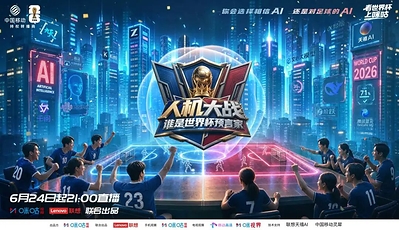
The campaign’s appeal lies in putting AI capabilities to the test under a single set of rules. Tens of millions of users have joined in, with the competition later moving to a live broadcast format. On June 24, Migu launched Human vs. AI: Who Predicts It Better?, a live studio show that pits celebrity guests against the models in real time. After every match, a public prediction accuracy leaderboard is released, turning what could have been a one-click gimmick into a serialized event that people follow and talk about.
Halfway through the tournament, several Chinese models have emerged as frontrunners. China Mobile’s Jiutian model currently leads the pack, hitting a 69% accuracy rate on single-match predictions as of July 7, giving it the highest success rate among the participating models. Furthermore, Jiutian has carved out an edge in calling draws and upsets. When the Netherlands faced Japan, most models predicted a Dutch victory. Jiutian alone called the draw. When Argentina beat Austria 2-0, Jiutian was the only model to nail the exact score. And in a high-profile Belgium-Senegal match, 11 models predicted a Belgian victory, while Jiutian alone was the only model to correctly call a 1-1 draw.
Other Chinese models have been bringing their own strengths to the table. Alibaba’s Qwen, Zhipu, and MiniMax have all been using multi-agent analysis to generate their forecasts. Kimi’s chatbot, for instance, can deploy as many as 300 AI agents to analyze tactics, player availability, injury records, weather conditions, and betting market odds. The Qwen app takes a similar approach, drawing on dozens of agents for each analysis.
For the companies behind these models, the World Cup represents far more than a marketing moment. It’s a rare, high-stakes stress test. Public prediction places every model on a level playing field, turning backend algorithmic prowess into interactive experiences that fans can see, compare and debate. The “Human vs. AI” showdown created by Migu and Lenovo not only adds a new layer of excitement and engagement to the World Cup — it also offers a real-time snapshot of the strengths of China’s large language model ecosystem.
 View original content to download multimedia:https://www.prnewswire.com/news-releases/migu-and-lenovo-turn-world-cup-predictions-into-a-human-vs-ai-competition-302822425.html
SOURCE Migu


