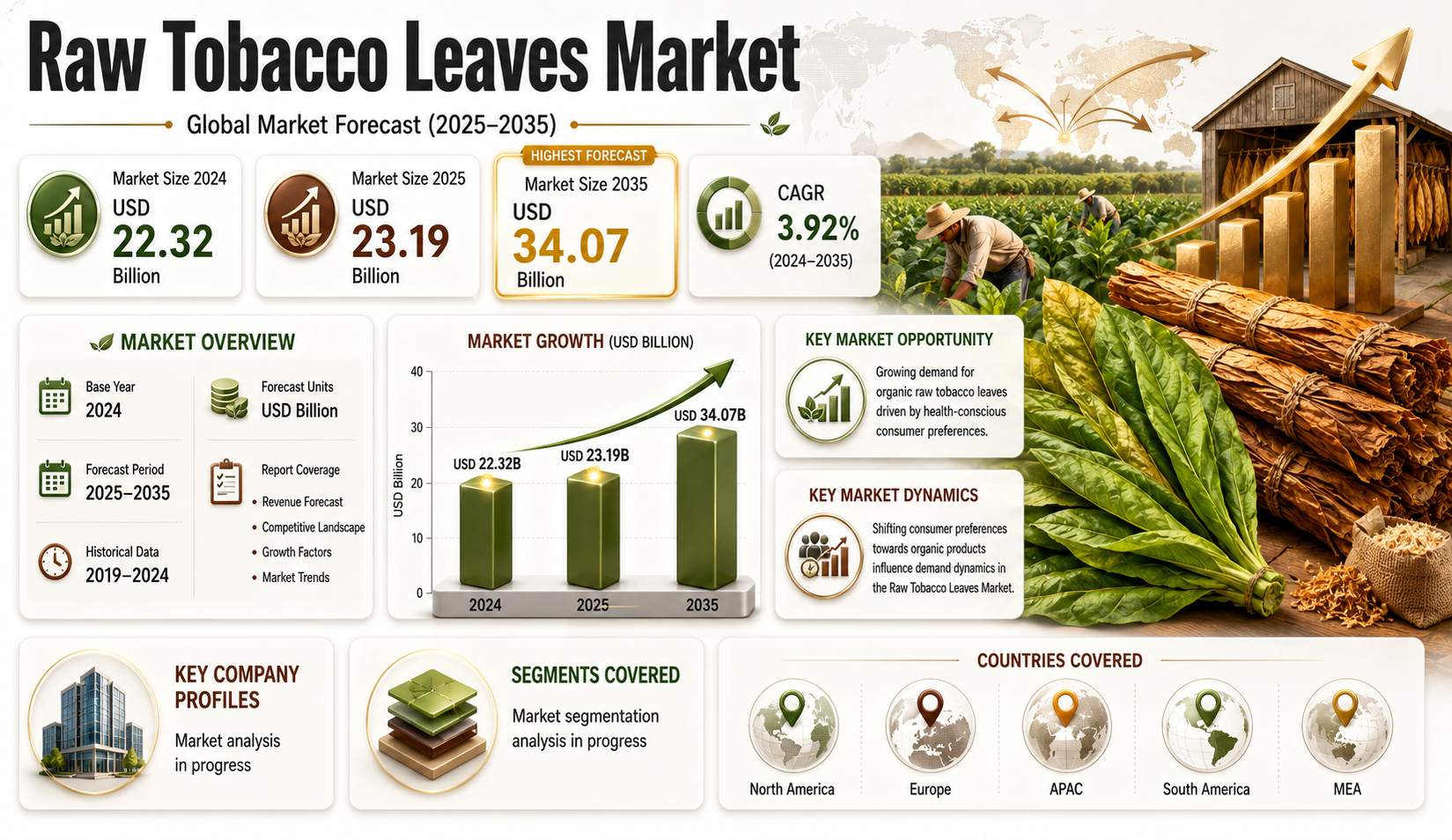
Raw Tobacco Leaves Market is projected to reach USD 34.07 billion by 2035, expanding at a 3.92% CAGR due to rising organic tobacco demand.
NEW YORK, NY, UNITED STATES, July 10, 2026 /EINPresswire.com/ —
The Raw Tobacco Leaves Market continues to demonstrate stable expansion as manufacturers, exporters, and tobacco processing companies respond to changing consumer preferences and evolving agricultural practices. Valued at USD 22.32 billion in 2024, the market is estimated to reach USD 23.19 billion in 2025 and is projected to attain USD 34.07 billion by 2035, registering a compound annual growth rate (CAGR) of 3.92% during the forecast period. Market expansion is being supported by increasing cultivation efficiency, rising demand for premium tobacco grades, and the growing preference for organically cultivated tobacco leaves across several regions.
One of the most influential trends shaping the industry is the increasing demand for sustainably grown raw tobacco. Consumers and manufacturers are paying greater attention to cultivation methods, encouraging farmers to reduce chemical inputs and adopt environmentally responsible farming practices. Organic tobacco cultivation is gradually gaining traction, particularly among premium tobacco product manufacturers seeking differentiated raw materials. Furthermore, technological improvements in curing, grading, storage, and logistics are helping producers maintain leaf quality while minimizing post-harvest losses.
Competitive Landscape
The competitive environment of the Raw Tobacco Leaves Market is characterized by regional growers, agricultural cooperatives, tobacco processors, exporters, and international supply chain participants. Companies are emphasizing sustainable farming partnerships, improved leaf grading technologies, contract farming, quality assurance programs, and supply chain optimization to strengthen their market presence. Investments in precision agriculture, digital farm management, and climate-resilient cultivation techniques are also becoming increasingly important as businesses aim to secure consistent raw material supplies while meeting evolving regulatory and customer expectations. Market analysis of major players and competitive positioning continues to evolve as industry participants expand production capabilities and geographic reach.
Free Sample Copy – Access A Complimentary Copy of Our Report to Explore Its Content and Insights.
https://www.marketresearchfuture.com/sample_request/10349
The market is further benefiting from improvements in global agricultural trade and increasing investments in tobacco-producing regions. Countries with favorable climatic conditions continue to expand production capacity, while exporters focus on maintaining consistent quality standards that meet international buyer requirements. The availability of improved seed varieties, modern irrigation systems, and advanced crop management practices has contributed to higher productivity and better-quality leaves suitable for diverse tobacco applications.
Although health awareness and tobacco control regulations continue to influence downstream tobacco consumption, demand for premium-grade raw tobacco remains relatively stable in several international markets. Manufacturers increasingly prioritize high-quality leaves with consistent texture, moisture content, aroma, and curing characteristics, supporting steady procurement from established producing regions.
Market Drivers
Growing demand for organic raw tobacco leaves remains one of the strongest drivers of market growth. Premium tobacco manufacturers are increasingly sourcing organically cultivated leaves to satisfy niche consumer segments seeking products produced with reduced chemical exposure. Sustainable agriculture certifications and environmentally responsible farming practices are becoming valuable differentiators across the global supply chain.
Technological advancements in farming are also supporting market development. Precision agriculture, drone-assisted crop monitoring, soil analysis, weather forecasting, and automated irrigation systems enable farmers to improve yields while reducing operational costs. Better harvesting and curing technologies help preserve leaf quality, resulting in higher market value and improved profitability for producers.
Market Challenges
Despite positive growth prospects, the industry faces several operational and regulatory challenges. Climate change introduces uncertainties such as irregular rainfall, prolonged droughts, flooding, and pest outbreaks, all of which can significantly impact tobacco cultivation and harvest quality. Farmers must increasingly adopt climate-resilient agricultural practices to maintain stable production.
Government regulations related to tobacco cultivation, environmental sustainability, labor standards, and international trade also influence market dynamics. Compliance with evolving regulatory frameworks often requires additional investments in farming practices, documentation, certification, and quality control processes.
Price volatility in agricultural commodities, fluctuating labor costs, and transportation expenses can further affect profitability across the supply chain. Producers continue investing in operational efficiency to mitigate these risks while maintaining competitive pricing.
Segment Analysis
By Product Type
The market includes several tobacco leaf varieties, each serving different manufacturing requirements. Flue-cured tobacco remains among the most widely cultivated varieties due to its balanced chemical composition and broad industrial applications. Burley tobacco continues to maintain strong demand because of its excellent blending properties and distinctive curing process. Oriental tobacco contributes unique aroma characteristics and is extensively utilized in premium tobacco blends. Dark-fired and specialty tobacco varieties cater to niche applications requiring specific flavor profiles and production characteristics.
Each product category differs based on cultivation methods, curing techniques, leaf texture, nicotine levels, color, and aroma, allowing manufacturers to develop diverse finished products for domestic and international markets.
By Cultivation Method
Conventional farming currently accounts for a substantial share of global production due to established agricultural infrastructure and cost advantages. However, organic cultivation represents one of the fastest-growing segments as consumer demand shifts toward sustainably produced agricultural commodities.
Organic farming minimizes synthetic fertilizers and pesticides while emphasizing soil health, biodiversity, and environmentally friendly cultivation practices. This transition supports premium pricing opportunities and strengthens long-term sustainability across the tobacco supply chain.
By Distribution Channel
Raw tobacco leaves reach end users through direct contracts, agricultural cooperatives, commodity traders, exporters, wholesalers, and specialized procurement agencies. Contract farming continues gaining popularity because it offers predictable pricing, technical assistance, and quality assurance for both growers and manufacturers.
International trade networks remain essential for balancing regional supply and demand, enabling manufacturers to source specific tobacco varieties from multiple producing countries based on seasonal availability and quality requirements.
Regional Analysis
North America maintains a stable position supported by advanced agricultural technologies, efficient logistics infrastructure, and established quality standards. Research initiatives focusing on sustainable cultivation continue strengthening production efficiency.
Europe emphasizes regulatory compliance, premium quality standards, and environmentally sustainable farming practices. Demand for certified and traceable agricultural products encourages producers to invest in responsible cultivation methods.
Asia-Pacific represents one of the largest production and consumption regions due to favorable climatic conditions, abundant agricultural land, and experienced farming communities. Countries across the region continue modernizing cultivation techniques while expanding export opportunities.
South America benefits from suitable growing conditions and increasing investments in commercial tobacco farming. Producers are adopting improved curing facilities and quality management systems to enhance international competitiveness.
The Middle East and Africa are gradually strengthening their participation through expanding agricultural investments, export-oriented cultivation, and improved farming infrastructure. Growing international trade relationships continue supporting regional market development.
Future Outlook
The long-term outlook for the Raw Tobacco Leaves Market remains positive despite evolving regulatory environments. Continuous improvements in agricultural productivity, sustainable farming technologies, climate-resilient cultivation practices, and international trade are expected to support steady market expansion throughout the forecast period.
Digital agriculture, precision farming, AI-driven crop monitoring, and advanced supply chain management solutions will further enhance production efficiency and product consistency. Growing consumer preference for organically cultivated tobacco leaves is expected to create attractive opportunities for producers investing in certified sustainable farming.
As manufacturers increasingly prioritize quality, traceability, and environmental responsibility, collaboration between growers, processors, exporters, and technology providers will become even more important. These developments are expected to strengthen supply chain resilience while supporting consistent revenue growth across the global Raw Tobacco Leaves Market through 2035.
Frequently Asked Questions (FAQs)
Q1. What is the projected size of the Raw Tobacco Leaves Market by 2035?
The Raw Tobacco Leaves Market is projected to reach USD 34.07 billion by 2035, growing from USD 22.32 billion in 2024 at a CAGR of 3.92% during the forecast period.
Q2. What are the primary factors driving market growth?
Key growth drivers include increasing demand for organically cultivated tobacco leaves, advancements in agricultural technologies, improved curing and storage methods, sustainable farming practices, expanding international trade, and rising demand for premium-quality raw tobacco from manufacturers worldwide.
Read Our Related Research Report
Pure Nicotine Market –
https://www.marketresearchfuture.com/reports/pure-nicotine-market-67641
Carob Market –
https://www.marketresearchfuture.com/reports/carob-market-7778
Mixed Tocopherols Market –
https://www.marketresearchfuture.com/reports/mixed-tocopherols-market-22248
Alcoholic Tea Market –
https://www.marketresearchfuture.com/reports/alcoholic-tea-market-24315
Lemongrass Oil Market –
https://www.marketresearchfuture.com/reports/lemongrass-oil-market-27086
Sagar Kadam
Market Research Future
+1 628-258-0071
email us here
Legal Disclaimer:
EIN Presswire provides this news content “as is” without warranty of any kind. We do not accept any responsibility or liability
for the accuracy, content, images, videos, licenses, completeness, legality, or reliability of the information contained in this
article. If you have any complaints or copyright issues related to this article, kindly contact the author above.

Media gallery