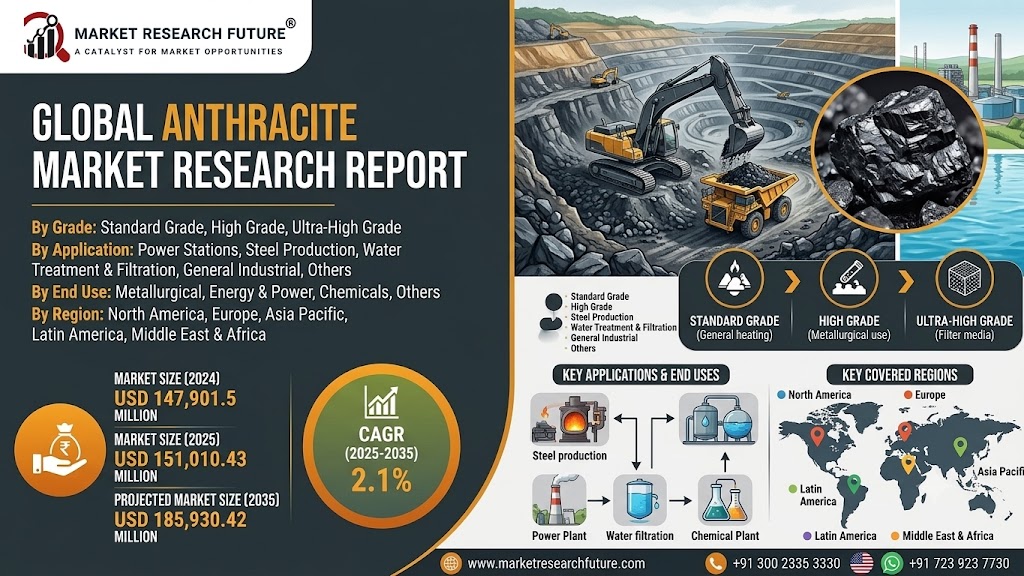
North America is poised to maintain its leadership in the anthracite market, holding a significant market share of 60,000.0 units
OR, UNITED STATES, August 27, 2026 /EINPresswire.com/ — The Anthracite Market is experiencing steady development as demand for high-carbon, low-impurity coal continues across heating, steel production, electricity generation, water treatment, cement manufacturing, and other industrial applications. Anthracite is recognized for its high carbon content, relatively low ash content, and high calorific value, making it valuable in applications where fuel efficiency and material quality are important. According to the latest Market Research Future data, the global Anthracite Market was valued at at 147901.5 USD Million in 2024. The Anthracite industry is projected to grow from 151010.43 USD Million in 2025 to 185930.42 USD Million by 2035, registering a 2.1% CAGR from 2025 to 2035.
Industrial Applications Support Anthracite Market Growth
Industrial applications remain an important foundation for the Anthracite Market. The material’s high carbon content and energy characteristics make it suitable for a range of processes where consistent heat and carbon content are required.
Steel production is one of the important industrial applications for anthracite. It can be used in metallurgical processes as a carbon source and fuel, supporting operations that require high-temperature environments. As infrastructure development and industrialization continue in emerging economies, demand for steel and related raw materials can create opportunities for anthracite suppliers.
Cement production is another emerging application. Anthracite can provide the high-temperature energy required in cement kilns, while its combustion characteristics make it suitable for specific industrial processes.
Heating Remains a Major Application
Heating is the dominant application segment in the Anthracite Market. Anthracite’s high calorific value and relatively low ash content make it attractive for residential and commercial heating applications.
Residential users have traditionally relied on anthracite for heating because it can provide consistent heat and efficient combustion. Commercial heating applications also contribute to demand, particularly in markets where anthracite remains an established energy source.
Although energy systems are gradually shifting toward lower-carbon alternatives, anthracite continues to have established applications in regions where coal remains an important component of the energy mix.
Download Report Sample Copy with TOC: https://www.marketresearchfuture.com/sample_request/2742
Electricity Generation Creates Additional Opportunities
Electricity generation is emerging as an important growth application. As energy demand increases, particularly in developing economies, anthracite can continue to serve selected power-generation applications.
Technological improvements in combustion and processing are helping operators improve efficiency and manage emissions. Modernization of energy infrastructure can create opportunities for anthracite producers and users to improve the performance of existing systems.
The growing emphasis on energy efficiency is also encouraging the development of technologies capable of extracting greater value from coal resources while reducing waste and improving operational performance.
Residential End Use Maintains Market Leadership
By end use, Residential is the dominant segment of the Anthracite Market. Residential demand is strongly associated with heating applications, where anthracite’s energy characteristics support household fuel requirements.
Commercial and industrial users also represent important demand centers. These sectors use anthracite for heating, manufacturing, metallurgical applications, and other specialized requirements.
Power Generation is identified as the fastest-growing end-use segment, supported by increasing electricity requirements and technological improvements that can enhance the efficiency of anthracite utilization.
This evolving end-use structure demonstrates that anthracite demand is not limited to traditional household heating but extends across a broader industrial and energy ecosystem.
Buy Now: https://www.marketresearchfuture.com/checkout?currency=one_user-USD&report_id=2742
Nut Coal Leads Product Demand
The product-type segment includes Nut Coal, Rice Coal, Stove Coal, and Pea Coal. Nut Coal is the dominant product type, benefiting from its versatility and suitability for various heating applications.
Its relatively larger particle size and high energy output make it suitable for residential heating systems as well as selected industrial applications. Consumers seeking reliable and efficient heating solutions continue to support demand for this product category.
Rice Coal is an emerging product type, gaining attention among smaller-scale users and specific industrial applications. Its compact particle size can make it suitable for particular heating systems and space-constrained applications.
High-Grade Anthracite Holds a Strong Position
By quality grade, the market is categorized into High Grade, Medium Grade, and Low Grade. High Grade anthracite holds the leading position, supported by its high carbon content and lower level of impurities.
High-grade material is particularly attractive for applications where consistent performance and energy efficiency are important. Steel production, heating, and specialized industrial applications can benefit from the quality characteristics of high-grade anthracite.
Medium Grade is an emerging segment, offering a balance between quality and cost. Its broader affordability can make it attractive to customers that require reliable performance while remaining sensitive to fuel costs.
Direct Sales Remains the Leading Distribution Channel
Direct Sales is the largest distribution channel in the Anthracite Market. Direct relationships between producers and end users can provide advantages in pricing, supply coordination, product specifications, and long-term procurement agreements.
Large industrial customers often require consistent volumes and specific quality grades, making direct purchasing arrangements particularly valuable.
Wholesale is the fastest-growing distribution channel, as industrial and commercial buyers increasingly seek bulk purchasing opportunities. Wholesalers can help consolidate supply and provide customers with more flexible procurement options.
Report Summary: https://www.marketresearchfuture.com/reports/anthracite-market-2742
Technological Innovation Improves Mining Efficiency
Technology is becoming increasingly important to the future of anthracite production. Mining companies are adopting improved extraction equipment, automation, monitoring systems, and processing technologies to increase productivity and improve operational safety.
Automated mining equipment can reduce manual intervention while improving extraction efficiency. Advanced processing technologies can also help producers improve material quality and reduce waste.
Digital monitoring and data analytics can support predictive maintenance and operational optimization. These technologies may allow mining companies to reduce costs while maintaining consistent production levels.
The adoption of technological solutions is particularly important as producers face increasing pressure to improve efficiency and manage environmental impacts.
Sustainability Influences the Market’s Future Direction
Sustainability is becoming an increasingly important factor in the Anthracite Market. While anthracite remains a fossil fuel, its high carbon content and low impurity characteristics have encouraged interest in improving combustion efficiency and reducing environmental impacts.
The industry is exploring cleaner processing methods, improved combustion technologies, and carbon-management approaches. Advanced carbon-capture technologies could provide opportunities to reduce emissions associated with anthracite utilization.
Mining companies are also investigating renewable energy integration. Such initiatives can reduce the operational carbon footprint associated with mining activities and support broader sustainability objectives.
Geopolitical Factors Shape Supply Chains
The geographic distribution of anthracite resources makes geopolitical developments an important consideration for the industry. Trade policies, international relations, transportation costs, and changes in mining activity can influence global supply and pricing.
Countries with significant anthracite reserves can play an important role in regional and international supply chains. At the same time, importing countries may seek to diversify suppliers to improve energy security.
Supply-chain resilience is therefore becoming increasingly important for industrial consumers. Long-term contracts, diversified sourcing, and improved inventory management can help mitigate potential disruptions.
Asia-Pacific Offers Strong Growth Potential
The global Anthracite Market spans North America, Europe, Asia-Pacific, Latin America, and the Middle East & Africa. North America remains the largest regional market, supported by its extensive industrial applications and established anthracite resources.
The Asia-Pacific region is emerging as the fastest-growing market, driven by increasing energy demand, urbanization, industrial development, and expanding manufacturing activity. China and other major Asian economies are particularly important because of their large energy and industrial requirements.
Growing steel production and infrastructure development across Asia-Pacific can create additional demand for anthracite in metallurgical and industrial applications.
Competitive Landscape
The Anthracite Market includes major companies such as Reading Anthracite Company, Blaschak Coal Corporation, Anthracite Coal Mining Company, Kryvyi Rih Iron Ore Plant, Shaanxi Coal and Chemical Industry Group, China Shenhua Energy Company, Yanzhou Coal Mining Company Limited, and Czech Coal.
Competition is influenced by resource availability, product quality, mining efficiency, supply reliability, pricing, and technological capabilities.
Companies are increasingly focusing on modern mining equipment, improved processing systems, supply-chain optimization, and sustainable operational practices. Strategic partnerships and investments in advanced technologies can also help producers strengthen their competitive positions.
Future Outlook for the Anthracite Market
The global Anthracite Market is projected to grow from 151010.43 USD Million in 2025 to 185930.42 USD Million by 2035, representing a 2.1% CAGR from 2025 to 2035.
Heating will remain an important application, while electricity generation, metallurgical processes, cement production, and water treatment provide additional demand opportunities. Residential use continues to lead end-use demand, while power generation is positioned for faster growth.
Technological advancements in mining, improved processing efficiency, supply-chain diversification, and cleaner utilization technologies will influence the industry’s future development.
Related Report
anthracite fines market https://www.marketresearchfuture.com/reports/anthracite-fines-market-39790
apac anthracite market https://www.marketresearchfuture.com/reports/apac-anthracite-market-45664
germany anthracite market https://www.marketresearchfuture.com/reports/germany-anthracite-market-45659
north america anthracite market https://www.marketresearchfuture.com/reports/north-america-anthracite-market-45661
china anthracite market https://www.marketresearchfuture.com/reports/china-anthracite-market-45665
russia anthracite market https://www.marketresearchfuture.com/reports/russia-anthracite-market-45666
calcined anthracite market https://www.marketresearchfuture.com/reports/calcined-anthracite-market-30645
europe anthracite market https://www.marketresearchfuture.com/reports/europe-anthracite-market-45662
japan anthracite market https://www.marketresearchfuture.com/reports/japan-anthracite-market-45660
south korea anthracite market https://www.marketresearchfuture.com/reports/south-korea-anthracite-market-45658
Market Research Future
Market Research Future
+1 855-661-4441
email us here
Legal Disclaimer:
EIN Presswire provides this news content “as is” without warranty of any kind. We do not accept any responsibility or liability
for the accuracy, content, images, videos, licenses, completeness, legality, or reliability of the information contained in this
article. If you have any complaints or copyright issues related to this article, kindly contact the author above.

Media gallery