YIWU, ZHEJIANG, CHINA, October 26, 2026 /EINPresswire.com/ — Procuring commercial kitchen sinks requires aligning basin architecture with culinary workflows, cabinetry spatial footprints, and daily maintenance demands. When evaluating a Global Advanced Kitchen Sink Supplier, wholesale distributors and multi-family developers compare traditional double-bowl configurations against contemporary waterfall workstation units. Manufacturing both structural formats, JIEPAI HOME supports commercial procurement teams with specialized sheet fabrication, tight dimensional tolerances, and scalable volume production. Understanding how layout geometry influences food preparation and dishwashing efficiency enables buyers to match target consumer demographics with high-performance kitchen fixtures. Sourcing teams gain the operational flexibility to satisfy diverse project specifications while maintaining uniform material standards across entire developments.
Kitchen Sink Supplier Comparison: Double-Bowl and Waterfall Assortment Needs
Selecting between a double-bowl sink and a waterfall workstation sink depends on culinary workflow zoning and countertop envelope dimensions. Double-bowl sinks partition concurrent food preparation and dish sanitation tasks across a 72×40 cm layout, whereas single-bowl waterfall sinks maximize continuous basin capacity within a 60×45 cm cabinet space. Evaluated under ASME A112.19.3 drainage and EN 13310 thermal resistance standards, both formats provide dependable commercial service. Dual-basin layouts prioritize strict task separation, allowing simultaneous food prep and tableware air-drying without cross-contamination.
The Model 7240 and Flying Rain 4.0 manufactured by JIEPAI HOME illustrate these functional alternatives. Both models utilize stainless steel, yet they feature distinct bowl depths, fabrication methods, and accessories. Examining these engineering differences enables buyers to select appropriate configurations for commercial apartments, residential developments, or retail showrooms.
The 7240 Double-Bowl Format Separates Kitchen Tasks
The Model 7240 provides a partitioned double-slot layout within a 72×40 cm outer footprint, featuring a 200 mm basin depth that fits standard 800 mm cabinet carcasses. This dual-compartment configuration enables kitchen workers to soak cookware in one basin while peeling vegetables or draining pasta in the adjacent bowl, avoiding cross-contamination during food preparation.
Constructed with 2 mm cold-rolled stainless steel, the unit employs precision CNC seam welding along the central dividing bridge. The 2 mm metal gauge resists flexure when supporting commercial cookware. Engineered channel grooves feature a 1.5-degree drainage slope guiding wastewater toward dual standard 110 mm basket strainers, preventing grease stagnation in basin corners. Heavy-duty undermount bracket clips and perimeter silicone bead channels ensure watertight mounting onto quartz countertops. Pre-formed faucet ledges accommodate commercial high-arc pre-rinse faucets without flexure.
Under-sink plumbing requires dual P-trap PVC junction kits with integrated mechanical overflow conduits to prevent cabinet flooding. Sourcing teams must verify internal cabinet widths and trap rough-in heights before specifying this double-bowl format for large-scale multi-family housing contracts.
The Flying Rain 4.0 Combines a Single Bowl With Waterfall Styling
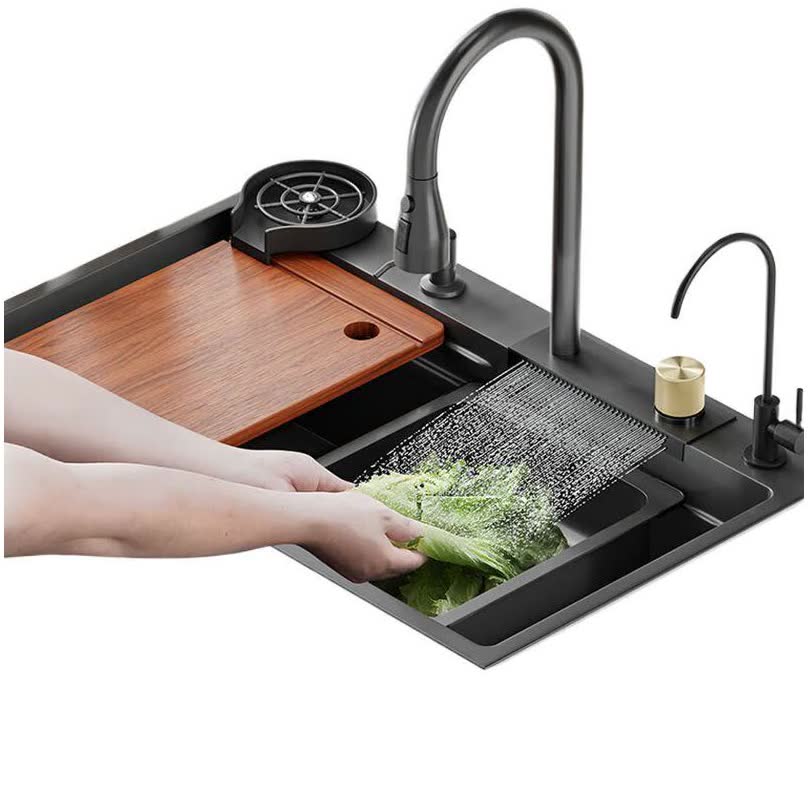
The Flying Rain 4.0 workstation sink measures 60×45 cm with an extra-deep 220 mm bowl, providing an unobstructed basin volume that accommodates large roasting pans and sheet trays. Fabricated using handmade processes, the sink incorporates a heavy-duty 4 mm top deck plate that resists deflection under heavy commercial pull-out faucets. The integrated waterfall dispenser utilizes a precision-engineered internal laminar manifold to deliver a gentle, broad water curtain for delicate produce washing. To prevent turbulent splashing, the waterfall channel operates optimally under municipal dynamic water pressures between 0.15 and 0.35 MPa.
The primary functional innovation is an integrated horizontal waterfall outlet built directly into the top faucet deck. This precision-slotted manifold disperses a broad, low-pressure laminar water curtain across the basin, allowing users to rinse delicate fruits and leafy greens without countertop water splashing. The sink rim features a stepped sliding track profile that supports custom sapele wood cutting boards, stainless colanders, and roll-up drying racks.
A high-durability nano-ceramic PVD coating protects the stainless steel surface against 5% vinegar acids, hot cooking oils, and abrasive scouring pads. Buyers can order tiered production volumes starting at 200 units, scaling to 1,000 and 5,000 pieces for large distribution programs. Integrated pre-drilled accessory ports accommodate push-button glass rinsers and soap dispensers.
Dimensions, Bowl Structure and Commercial Terms Change the Buying Decision
Selecting between these two sink architectures requires comparing dimensional geometry, kitchen ergonomics, and supply chain logistics:
Basin Architecture: Model 7240 features a divided double-slot format for parallel task handling; Flying Rain 4.0 provides a single large basin paired with a waterfall water dispenser.
Outer Footprint: Model 7240 measures 72×40 cm; Flying Rain 4.0 measures 60×45 cm, fitting more compact 700 mm cabinet carcasses.
Vertical Clearance: Model 7240 offers a 200 mm depth; Flying Rain 4.0 offers a 220 mm depth, providing greater splash containment.
Fabrication Method: Model 7240 utilizes CNC automated seam welding; Flying Rain 4.0 uses handmade construction with a 4 mm deck plate.
Commercial Options: Flying Rain 4.0 supports modular accessories and structured volume pricing tiers at 200, 1,000, and 5,000 pieces.
Assortment planning balances these engineering trade-offs against target consumer demographics. Retail home centers often stock both designs to serve conventional households preferring segregated washing zones and urban apartment buyers demanding compact multi-functional workstation sinks.
Nested carton packaging stacks smaller accessories inside the basin cavity, reducing outer carton volume by thirty-five percent and maximizing container utilization during ocean freight transit. Molded corner pulp trays prevent rim bending during rough intermodal transshipment.
Frequently Asked Questions About Double-Bowl and Waterfall Kitchen Sinks
What Is the Main Difference Between the Two JIEPAI HOME Sink Styles?
The Model 7240 is a divided double-slot sink designed for concurrent washing and rinsing. Meanwhile, the Flying Rain 4.0 is a single-basin sink integrating a horizontal waterfall wash bar for enhanced workstation utility.
Which Model Has the Deeper Bowl?
Flying Rain 4.0 features a 220 mm depth, which provides 20 mm more vertical clearance than the 200 mm depth of Model 7240, reducing splash-back when cleaning deep stockpots.
Does the Waterfall Sink Support Customization?
Yes. Flying Rain 4.0 supports OEM customization, including custom nano-PVD color coatings, laser logo engraving, custom cutting board accessories, and branded packaging.
Why Should Buyers Compare Dimensions Before Choosing a Style?
Dimensions dictate countertop cutout templates and cabinet carcass compatibility; the 72×40 cm format requires wider base cabinets than the 60×45 cm format, directly affecting installation logistics.
What Should a Distributor Send When Requesting Sink Options?
Distributors should specify preferred basin configuration, target dimensions, stainless steel thickness, estimated volume, customization requirements, and sample delivery requirements.
Build the Kitchen Sink Assortment Around the Target Buyer
Matching sink basin geometry to target kitchen workflows and cabinet footprints ensures long-term customer satisfaction and reduced product returns. Structured dimensional planning from initial model selection to container delivery streamlines commercial procurement.
Commercial kitchen specifiers and wholesale distributors can send target basin dimensions through the JIEPAI HOME storefront to review DXF cutout files, workstation accessory matrices, and volume price schedules.
JIEPAI HOME
JIEPAI HOME
Legal Disclaimer:
EIN Presswire provides this news content “as is” without warranty of any kind. We do not accept any responsibility or liability
for the accuracy, content, images, videos, licenses, completeness, legality, or reliability of the information contained in this
article. If you have any complaints or copyright issues related to this article, kindly contact the author above.

Media gallery